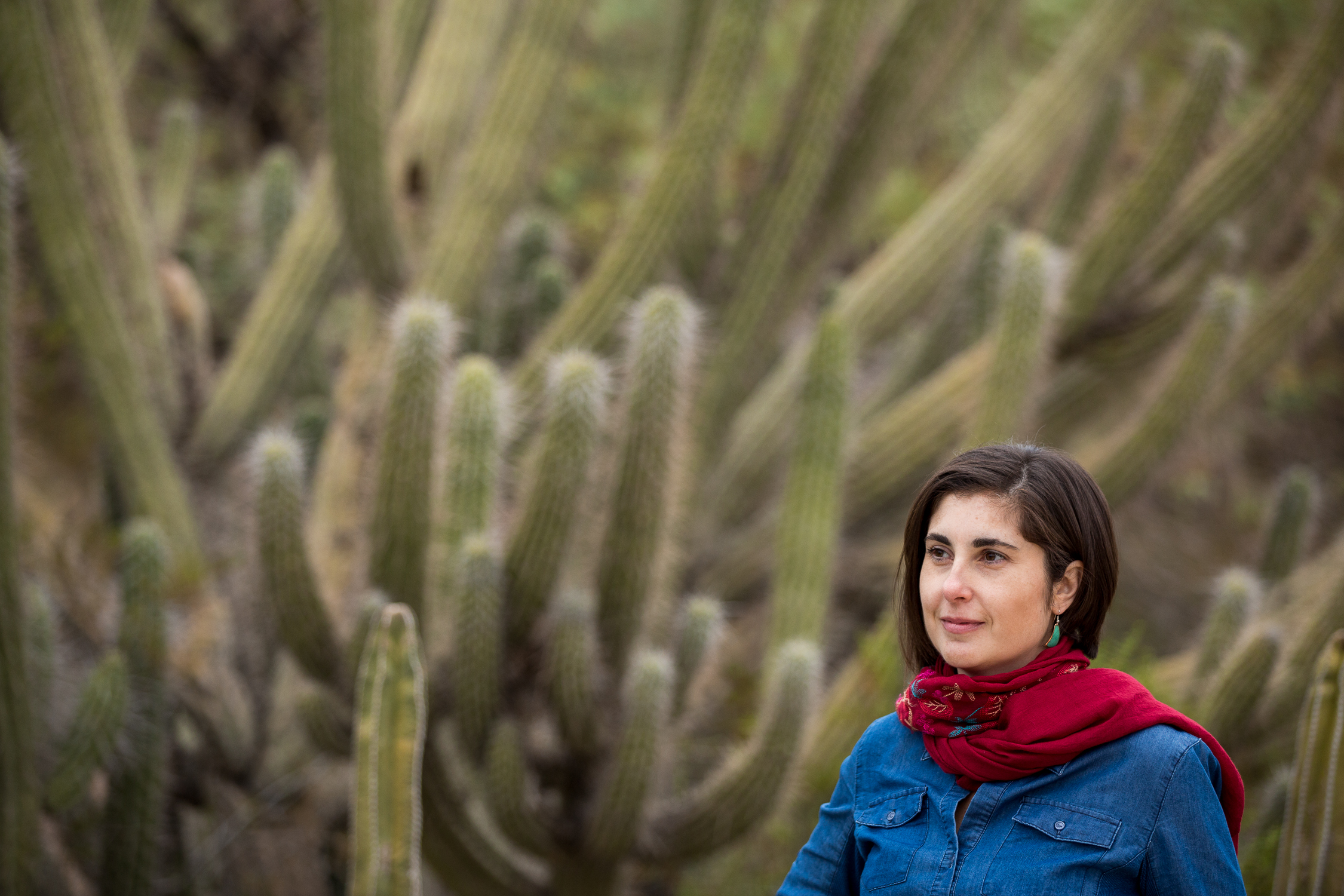
Journalist Valeria Fernandez. Photo by Drew Bird.
Valeria Fernández has illuminated immigrant life in the Southwest through stories published in outlets such as CNN International, The Guardian, and PRI’s The World. For this work she won $100,000 as one of the first two recipients of the American Mosaic Journalism Prize for independent journalism.
Yet, Fernández once doubted her readership would ever expand beyond a small audience of Spanish speakers in Arizona. She immigrated from Uruguay and started her career as a reporter at La Voz Arizona, a Gannett-owned Spanish-language weekly.
“The Latino media, the Filipino media, they’re covering the stories first, but sometimes it just stays there,” said Fernández, who is now director of Cronkite Noticias at Arizona State University, a multiplatform outlet at which students report in Spanish.
Two organizations that nurture ethnic media reporters have helped Fernández cross over to English-language legacy media. Feet in 2 Worlds and New America Media provided her with skills to make the leap to mainstream media; translated her stories to a larger, English-speaking audience; and connected her to ethnic media reporters from other backgrounds.
“They literally trained me how to write effectively in English, and they also provided me the freedom and the platform for all of the stories. They saw value [in] the stories that were going on in the grassroots level in the community, and they were hungry for them,” Fernández said.
“It just made me understand the significance of getting this information out there,” she said. “There is a place for the stories of this community beyond this loop of reporting for ourselves.”
This article, one of the American Press Institute’s Strategy Studies, is the third in a series about fostering effective collaborations between mainstream and ethnic media outlets. These collaborations can open up new avenues of storytelling, expand reach, and illuminate stories that editors at mainstream publications miss.
In our first post, we discussed the different forms these collaborations can take and outlined some of the obstacles. In our second, we looked at foreign-language publications owned by companies that also run larger, mainstream, English-language publications.
In this post, we delve into the lessons newsrooms can learn from organizations that support collaborations. These facilitators have the trust of ethnic and mainstream publications, and they can assist them with translation, training, and cultural and stylistic adaptation of stories.
While a few organizations connect ethnic media and mainstream news outlets around the U.S., many communities lack the access or means to bring in a facilitator. Some elements of successful collaborations, however, can be applied to any newsroom: how to understand the ethnic media landscape, how to establish mutually beneficial relationships with publications, and how to recognize a good story if it isn’t written in AP style — or even in proper English grammar.
“Lots of journalism organizations sincerely do want to serve growing populations,” said John Rudolph, executive producer and cofounder of Feet in 2 Worlds. “They want to expand their audience, they want to be more comprehensive in their coverage, and they don’t know how to do it.”
How facilitators connect ethnic media reporters to the mainstream press
Feet in 2 Worlds has served as a bridge and talent pipeline between ethnic and mainstream media for almost 15 years.
It started in 2005 when Rudolph pitched to New York public radio station WNYC a documentary about how immigrant New Yorkers’ lives had changed after 9/11. The late Frank McCourt, the Pulitzer Prize-winning author of “Angela’s Ashes,” agreed to be the host. Reporters from the local Polish, Haitian and Indian press were paired with producers who trained them in radio reporting.
Karen Frillmann, executive producer for narrative news at WNYC, said the one-hour show was transformative. She first joined the station in 1979 and returned in 2003. She admitted the editorial team had failed to reflect the diversity of the city.
“WNYC knew that we were missing lots of really rich stories that were taking place in New York City, and for a long time the excuse was, ‘Oh well, we can’t find qualified people,’” Frillmann said. “Feet in 2 Worlds became this bridge.”
After the documentary aired, WNYC hired one of the reporters, Arun Venugopal, who had reported on the gay South Asian scene. Venugopal had been at the weekly India Abroad; he is now a host and reporter at WNYC covering race and immigration.
“If it hadn’t been for Feet in 2 Worlds,” Venugopal said, “there’s a chance I wouldn’t have found a job in the mainstream.” Other reporters who have received Feet in Two Worlds mentorship and training include Annie Correal (now at The New York Times), Catalina Jaramillo (a part-time reporter at PlanPhilly) and Martina Guzmán (a contributor to PRI).
These experiences can be enriching for ethnic media reporters even if they aren’t spurred to leave for the mainstream press. Rong Xiaoqing, a reporter for Sing Tao Daily, said working with Feet in 2 Worlds, New America Media and CUNY’s Center for Community and Ethnic Media has helped keep her at Sing Tao. Through these projects, her stories reach broader audiences, and her writing benefits from deeper editing than at her newspaper.
“I do feel that I am doing what I want,” Xiaoqing said, because she gets to report deeply on Chinese-American issues for Sing Tao, freelance for English-language media and participate in collaborations with these groups. But she acknowledged that these collaborations are not for everyone: “It’s not like everybody would be enthusiastic about doing this, because it takes more time.”
Feet in 2 Worlds went on to become a project of the Center for New York City Affairs at The New School, where it trained ethnic media reporters to produce stories for public radio and other news outlets. Rudolph said they are taking steps to open a second branch in Detroit as early as the summer of 2018.
He believes more communities could benefit from Feet in 2 Worlds’ formula of training talented reporters in ethnic media and placing them in partnerships with mainstream outlets. In particular, he sees potential in cities like Los Angeles, Houston and Miami — places, he said, with “big immigrant communities, lots of ethnic media, academic institutions and mainstream media that have the potential to serve those communities in a much better way.”
Find ways to serve different audiences
After working with a number of editors and collaborative organizations, Fernández developed an approach in which she uses the same ingredients but a different style for each audience.
She cited her coverage of immigration as an example. “When you’re writing for an immigrant community, it’s informational, it’s like consumer reporting,” she said. Stories for American readers, on the other hand, have more “background information to understand how policies work, but it doesn’t apply to their lives.”
During USC’s Center for Health Journalism fellowship, each reporter and editor is asked the same question: “Are you reporting for a community or about it?” In writing stories with two angles, Fernández effectively reports both for and about these communities. But very few reporters can do that on their own.
Chapter 4 of this series, soon to be published, will go deeper on how ethnic media provides service journalism.
Act as interpreters, not just translators
Zaman Amerika, a Turkish-language newspaper in New Jersey, published an unusual story in August 2017 that gained an unusual amount of local traction.
“Immigrant, Muslim and voting Republican in New Jersey,” by Orhan Akkurt, profiled a Turkish immigrant and lifelong Democratic voter who decided to support a Republican nominee in the 2017 governor’s race because he preferred a woman governor. The English version of the story was published by NJ Spotlight and picked up by Philly.com.
The story was part of a collaboration, Voting Block NJ, that brought together more than a dozen mainstream and ethnic media outlets.
For Akkurt, the collaboration was a welcome opportunity. He has struggled to keep Zaman Amerika alive since the Turkish government took over its mother company, which publishes the country’s largest newspaper. His paper typically covers issues that affect people throughout the U.S., but this partnership enabled him to dive into a local election. And it helped his stories reach a wide audience beyond Turkish readers.
“I knew someone was going to edit my articles, publish in other websites, and I have a chance to reach more than our regular website,” Akkurt said. “I have a chance to reach an American audience.”
Akkurt translated his story to English. Then Anthony Advincula, who was editor and national media director of New America Media, guided him and the other ethnic media reporters through something of a cultural translation.
“It’s not just about the English language, the structure, but more so the nuances of the story, culturally,” Advincula said. Akkurt, for example, “did not mention how many Turkish Americans are in the New York City area, and if you are a general reader, not coming from the Turkish community, you want to know that.”
Voting Block NJ was coordinated by the Center for Cooperative Media at Montclair State University, the Center for Investigative Reporting in the Bay Area, and New America Media. Other partners included The African Sun Times, the Spanish-language Reporte Hispano and Chinese-language Sing Tao Daily.
The sort of cultural translation Advincula described is familiar to Xiaoqing through her work for Voting Block and other collaborations. When writing in Chinese about bubble tea, she said, a reporter wouldn’t explain, “bubble tea, which originally is from Taiwan, with the bubbles made from some kind of sticky rice.” That would be like breaking down the ingredients in a milkshake. But that sort of description is often needed in mainstream media.
Xiaoqing, who has been published in the New York Daily News and City Limits and serves as a translator for Voices of NY, said there also are differences of style. Chinese stories are often longer than English-language stories and are structured differently.
The Center for Cooperative Media, which published a study on different models of collaborative journalism in 2017, has found teaming up with ethnic media poses particular challenges.
Stefanie Murray, director of the center, said some English-language partners in Voting Block were initially concerned about publishing ethnic media stories because they typically aren’t written in the same structure and they don’t follow AP style.
After Advincula worked with ethnic media journalists, Murray said, the English-language stories “came out much more like what the editors would expect.”
New America Media, and Advincula in particular, provided a crucial bridge for the project, Murray said. “They had built relationships with ethnic newsrooms here and had the capacity to handle translation and content-sharing for collaborative projects.”
Finding facilitators after New America Media
For 45 years, New America Media supported the ethnic press by organizing collaborations, fellowship programs and briefings on reporting topics. It closed in November 2017 due to funding problems.
No single organization now acts as a national convener for ethnic media. Murray said that will hinder collaborations between ethnic and mainstream outlets.
“It’s going to be important for organizations like ours to reach out and include ethnic media newsrooms in our networks so we can be sure they’re involved from the start in future collaborative projects,” Murray said. “It’s something we really should be doing anyway, and not necessarily relying on a singular association like NAM to do that heavy lifting and relationship-building for us.”
Former Executive Director Sandy Close continues the organization’s mission on a limited basis with Ethnic Media Services, briefing ethnic media reporters on issues such as immigration policy, Census reform and stormwater retention.
Some big cities have their own initiatives. The City University of New York runs the Center for Community and Ethnic Media, which provides training and research on the sector, publishes translations of ethnic media stories on Voices of NY, and administers the Ippies journalism awards for ethnic and community reporting.
In Chicago, Public Narrative is renewing and expanding its work with the city’s 200-plus ethnic and community media outlets. For years, the nonprofit organization has nurtured collaborations among independent outlets, including periodic “speed-dating” programs that bring together experts to explain issues.
For the past eight years, the publishers of five of the biggest ethnic media news outlets in the Detroit metropolitan area — representing Korean, black, Arab, Jewish, and Latino communities — have met monthly with professor Hayg Oshagan of Wayne State University to discuss issues, share stories and leverage their common interests. The initiative, New Michigan Media, has collaborated with local mainstream outlets and recently updated a directory of 125 ethnic media outlets in the state.
The Boston Institute for Nonprofit Journalism, known as BINJ, has an ongoing partnership with Spanish-language outlets such as El Planeta, and it regularly promotes the work of local ethnic journalists.
But most smaller cities and towns lack an organization that supports these collaborations. If your news outlet cannot find someone to help you work with ethnic media, you can take this on yourself.
Trying out your own collaborations
Angilee Shah, a senior editor at PRI’s Global Nation, which covers immigration in the U.S., has found it more effective to work directly with media outlets and ethnic media reporters rather than going through an interlocutor. She advised finding strong partners and building relationships so you can “reach a true collaboration that is not extractive or patriarchal — which means you want partners you can work with, or respect.”
Michelle Levander, director of the Center for Health Journalism at the University of Southern California, said mainstream journalists who report for influential outlets often do not know how to reach the communities they cover. One of the best ways to overcome that is to pair them with ethnic media reporters, both informally and in partnerships. “We advertise for every fellowship that we give priorities for ethnic and mainstream collaborations,” Levander said. “We feel that the two types of media are in silos and rarely interact.”
Levander and other facilitators say you should keep a few things in mind if you want to strike out on a collaboration on your own:
Diversify your networks: Levander has found that reporters often don’t know one another, even if they report in the same geographic area. “You may be at the same press conference for years and not contact each other,” she said. If you aren’t aware of one another, you aren’t going to collaborate. Informal relationships often lead to professional ones.
Realize collaborations can take many forms, as long as both sides benefit: A partnership does not necessarily mean both outlets run the same story. And, Levander said, “you can share bylines or not share bylines.” The important question, she said, is whether there is a mutually beneficial way “in which you and your ethnic media collaborator can inform each other’s work.”
Recognize your interests probably won’t be the same: As we researched these issues, ethnic media reporters often raised two complaints: Too often they’re brought in after the planning process, and the stories typically are geared toward the needs of mainstream outlets rather than their own. Good facilitators make sure everybody is at the table from the beginning. “You need to take a step back and recognize what we’re doing and how we’re doing it,” said Oshagan of New Michigan Media. “We may not want the same training that you think is appropriate for us. The ethnic media do many different things than the mainstream.”
Be ready to be teacher and student. Facilitators often help each side of a partnership realize what they can offer and what they need. That exchange of skills was demonstrated by Surging Seas, a multimedia project that New America Media facilitated about the impact of rising sea levels in California. The series was a mix of data-driven and hyperlocal reporting involving six Bay Area ethnic and community media outlets, IRE, Climate Central and Stamen Design. The ethnic media reporters got valuable training in data journalism, and other reporters benefitted from on-the-ground knowledge.
Involve leadership in collaborations: To make a collaboration work, the head of each news outlet must buy into it. They should be working their own connections, getting acquainted with their counterparts at other media outlets, and setting up meetings on their own. “It’s a news leadership question,” Levander said. “There’s enough reasons in today’s news economy to have a collaboration and not fall back on those competitive models.”
Share with your network
You also might be interested in:
We’re almost halfway through the year, and Mental Health Awareness Month is a good time to pause and reflect on our well-being and that of our newsrooms.
New year, same old meetings. Meetings that don’t include the right people or that include too many people. Meetings that could have been an email. But what if it didn’t have to be that way? As we kick off 2026, API wants to help you reset and rethink key meetings in your news organization.
It’s been a busy year for us: we held three API Local News Summits, built out a comprehensive guide to partnering with influencers, encouraged experiments with grants and cohorts, and supported news organizations with our products.


